Author: Tall Ship Windy

Here are 8 great ways to celebrate Black History Month in Chicago

Here are 8 great ways to celebrate Black History Month in Chicago

Soak in some jazz, revel in an all-night dance party, relive the March on Washington and other things to do in Chicago this month.

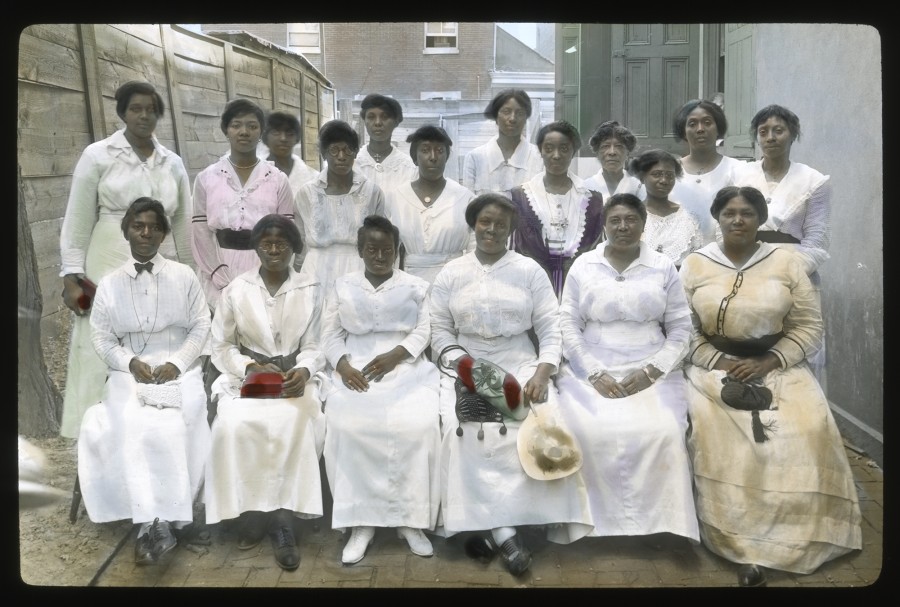
Photo of women workers, East Calvary Ch. Dated to ~1922. Slide 31 out of 44.
Photo of women workers, East Calvary Ch. Dated to ~1922. Slide 31 out of 44. Courtesy of the Newberry Library

February is Black History Month. Explore the city all month long with food from Black-owned businesses, jazz concerts, exhibitions featuring Black artists and scientists, and more.

Get jazzy

For music-lovers, get a two-in-one by celebrating the day of love and Black History month with The South Side Jazz Coalition. On Valentine’s Day, the ensemble – piano, guitar, bass and drums with guest vocalists – will perform a free concert of jazz classics.

Feb. 14 at Compassion Baptist Church (2650 E.95th St., Chicago). Free. Register here.

Don’t stop the music

A nonstop dance party? Art, body painting, and a photography stage? Experience this and more at the Afrofuturism Stage: Chicago presented by Electro Afro Stage and Wakanda Music Festival. All night, DJs, producers, presenters and artists will perform.

Time travel back into history

The Newberry Library in the Gold Coast has a new collection of rare, hand-colored images documenting the Great Migration, when African American communities relocated from the South to the urban North. The collection is the most complete set to survive, with 44 glass slides that capture the daily life of Black migrants. The images – many of which have never been published before – were used by the Methodist Episcopal Church to raise funds and inform people interested in moving to Chicago.

Available to view online or at the Newberry Library (60 W. Walton St., Chicago).

A dress making class at St. Mark's Church in Chicago from 1922.
A dress making class at St. Mark’s Church in Chicago from 1922. Courtesy of the Newberry Library

Explore new technologies

The DuSable Black History Museum and Education Center is offering a groundbreaking, immersive virtual reality exhibit that allows visitors to attend and witness the 1963 March on Washington. The exhibit first opened in 2020 and was created by TIME in collaboration with Viola Davis.

Through February at the DuSable Black History Museum (740 E. 56th Pl., Chicago). Tickets free for Illinois residents. Exhibition free with museum admission.

Melt the icy Chicago winter with Black joy

At Second City, the Dance Like There Are Black People Watching: A Black Excellence Revue show features a cast of rising comedy stars, brand-new sketches, songs and improv.

Fridays and Saturdays through February at The Second City (230 W. North Ave., Chicago). Tickets start at $29.

See the work of Black artists from around the country

The Museum of Science and Industry opened its 2023 Black Creativity Juried Art Exhibition. Engage with rich contemporary art such as paintings, art prints, sculpture, ceramics and photography by more than 50 Black artists – including youth artists from 14 to 17 years old. Displayed annually since 1970, it is the longest-running exhibition of African American Art.

Through Apr. 23 at the Museum of Science and Industry (5700 S. DuSable Lake Shore Drive, Chicago). Ticketsstart at $21.95; discounts for residents, children and EBT card holders.

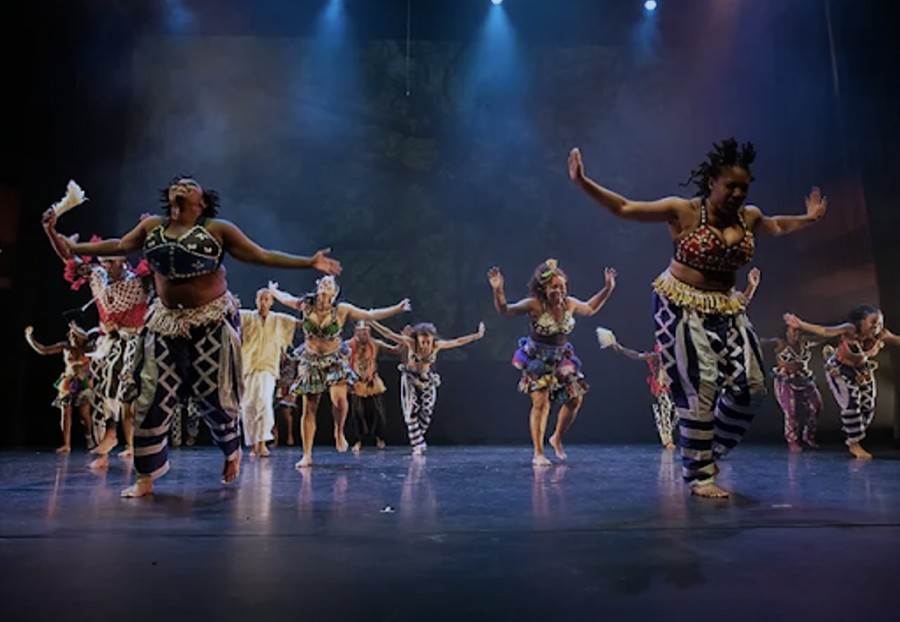
The Muntu Dance Theatre will perform at Field Museum on Feb. 20 as part of a celebration highlighting the Field Museum's Africa Hall.
The Muntu Dance Theatre will perform at Field Museum on Feb. 20 as part of a celebration highlighting the Field Museum’s Africa Hall. Courtesy of the Field Museum

Learn about Black scientists, artists, and icons

This year marks the 30th anniversary of the Field Museum’s Africa Hall opening, and the celebration includes several events throughout February – all on free days. And, if you can’t make it in-person, the events are also being streamed remotely via Zoom and Facebook Live. The month is packed, with panels about being Black in STEM on Feb. 8 and Feb. 15; meetings with a museum insider to learn about the West African sande/bundu mask on Feb. 14; and the Muntu Dance Theatre performance on Feb 20.

Through Feb. 28 at the Field Museum (1400 S. DuSable Lake Shore Dr., Chicago). To see all the events and register, click here.

Feed your soul

Chicago Restaurant Week may be over but the Chicago Black Restaurant Week is just starting. Twenty-four restaurants are participating, featuring Southern classics, baked goods, and even vegan options.

The two-week dining event runs Feb. 12 to 26. chiblackrestaurantweek.com

Chicago Theatre Week kicks off

Chicago Theatre Week kicks off

This year’s celebration focuses on Black History Month, while Black circus artists take the spotlight at Aloft.
A scene from Trial in the Delta. At left, a middle-aged bald Black man in shirtsleeves, suspenders, and tie stands behind a table covered with law books. He is pointing toward a white man seated at a table whose back is to the camera. Several other white men are also seated, facing the Black man who is testifying. On the right is a white attorney in a dark suit and tie, who is holding a portfolio or notebook of some kind.
A scene from Trial in the Delta: The Murder of Emmett Till, presented by Collaboraction at the DuSable Black History Museum and Education Center through February 19. The production is part of Chicago Theatre Week, running through February 26.Credit: Joel Maisonet

“If you see our show, that’s at least two spots on your bingo card!”

That’s what Jimalita Tillman, global director for the Harold Washington Cultural Center, said at the Chicago Theatre Week kick-off party Monday night at Wicker Park’s Den Theatre.

She wasn’t being metaphorical either. Theater audiences who check out participating shows starting today through February 26 can literally fill out a bingo card, with slots for categories such as “a comedy,” “a show at a theatre you’ve never been to,” and “a show on the south side of the city.” (Turn in your completed card with proof of attendance by March 1, and you can be entered in a drawing for two free theater tickets and a restaurant gift card.) Tillman, whose original musical comedy Queens of the Policy is running through Broadway in Bronzeville at the HWCC (4701 South King Drive), was betting that audiences may not have been to see her company before. And talking about bingo felt like an appropriate intro for the high-spirited musical numbers in Tillman’s show, which features alums of the theater’s Off the Streets, On the Stage training program.

Queens of the Policy, set in Bronzeville in the 1940s, portrays the Black women who entered the previously male-dominated (and sometimes mobster-dominated) world of “policy,” a forerunner of the lottery. Many of the women, in addition to running the games, had deep roots as activists and philanthropists in their communities.

Now in its 11th year, Chicago Theatre Week is a project of the League of Chicago Theatres, the service organization that represents around 200 producing organizations in the city and suburbs. It’s presented in partnership with Choose Chicago, and the goals are to encourage new audiences to check out Chicago theater and to encourage regular patrons to sample companies whose work they’ve not previously encountered. Discounted tickets ($15-$30 or less) are available as well as special dining offers through participating restaurants.

Since it coincides with Black History Month, this year’s Chicago Theatre Week also places the spotlight on Black theater artists and productions. In addition to Queens of the Policy, the showcase at the kick-off party included a scene from Micah Ariel Watson’s Alaiyo, produced by Definition Theatre at the Revival; Invictus Theatre‘s production of Katori Hall’s The Mountaintop (opening in previews tonight); and Columbia College Chicago’s production of Dominique Morisseau’s Detroit ’67, running through February 18. (The Invictus and Columbia College productions are both directed by Aaron Reese Boseman.)

Despite concerns overall in the theater industry about the return of audiences since the 2020 COVID-19 shutdown, the League notes that advance ticket sales for Chicago Theatre Week have been robust and could end up besting the previous record from 2020 (pre-shutdown) of 13,400 tickets.

Lots of other shows participating in Chicago Theatre Week also offer stories tied to Black History Month, and several of them are recommended by Reader critics. They include Trial in the Delta: The Murder of Emmett Till with Collaboraction at the DuSable; Lady Day at Emerson’s Bar and Grill at Mercury Theater Chicago’s Venus Cabaret; Boulevard of Bold Dreams at TimeLine; and Toni Stone at the Goodman.

You can check out all the participating companies and start filling out your own bingo card at chicagotheatreweek.com.

Amanda Okolo performs as part of the Black History Month Cabaret with BIPOC Circus Alliance Midwest at Aloft. Courtesy the artist.

Black circus arts in the spotlight

This Saturday at 8 PM, BIPOC Circus Alliance Midwest (BCAM) presents a Black History Month Cabaret at Aloft Circus Arts (3324 West Wrightwood). A dozen Black movement artists will demonstrate their skills in hammock, silks, straps, flying pole, and more. Tickets are currently sold out, but you can contact bipoccircusalliance@gmail.com for information about the organization. They have a three-part mission: “Advocating for equity and inclusion in training, teaching, and performance space; Partnering with circus organizations to implement policy changes designed to increase BIPOC representation and inclusion within students and staff; Celebrating and amplifying BIPOC stories in circus.”

12 pieces of Chicago history hidden in plain sight

Some of Chicago’s oldest buildings, museums and water towers allow visitors to travel back in time.

Written by

You can’t step inside a time machine and explore the past (not yet, at least), but you can experience bygone days by visiting the places where history transpired. There are elements of Chicago history scattered throughout the city that date back to its incorporation in 1837—you simply need to know where to look. One of the best museums in Chicago resides in a building that dates back to the World’s Colombian Exposition of 1893, while the site of a notorious gangster’s last stand can be visited across the street from a popular Chicago music venue. Want to learn more about Chicago history through present-day exploration? Check out these important pieces of Chicago history hidden in plain sight.

The Museum of Science and Industry

Photograph: J.B. Spector

The Museum of Science and Industry

The fabled White City sprung up in Jackson Park during the World’s Colombian Exposition of 1893, hosting technological and cultural exhibitions for six months—but the majority of the neoclassical buildings were temporary and designed to be torn down at the event’s conclusion. One exception was the Palace of Fine Arts, built with bricks to protect the art displayed there during the Exposition. Eventually, the vacant building was transformed into the Museum of Science and Industry, which opened in 1933. Builders replicated the Beaux Arts design with Indiana limestone, retaining the columns and ornamentation of the original structure. Stand on the museum’s southern steps, look across the Columbia Basin and imagine the White City stretching out in front of you.

Union Stock Yards Gate

Photograph: Shutterstock

Union Stock Yards Gate

Chicago earned its nickname “hog butcher for the world” thanks to the acres of livestock pens and slaughterhouses that could be found beyond the Union Stock Yards gate from 1865 to 1971. Hundreds of thousands of pigs, cows and sheep were slaughtered and processed with industrialized precision each year—all taking place in a harsh environment that journalist Upton Sinclair immortalized in his 1906 novel The Jungle. Today, only the gates of the Union Stock Yard remain near the intersection of W Exchange Avenue and S Peoria Street, acting as the entrance to a memorial that commemorates Chicago firefighters who have died in the line of duty.

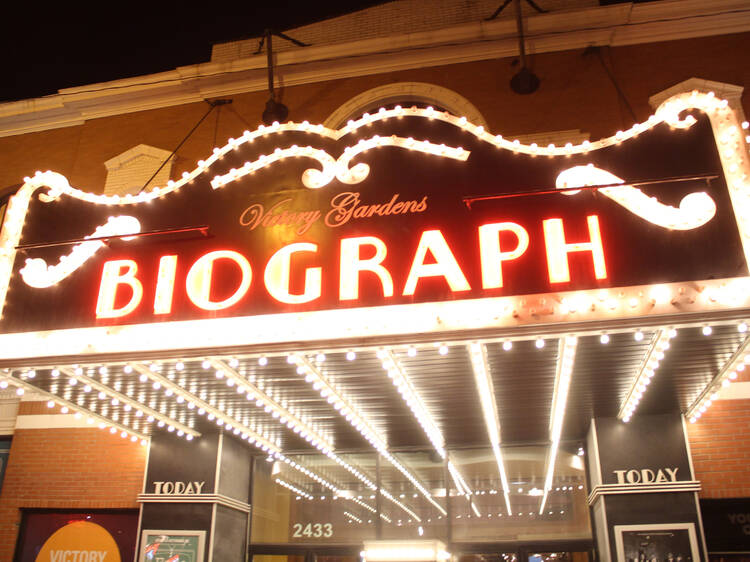
Biograph Theater

Photograph: Shutterstock

Biograph Theater

On July 22, 1934, notorious gangster John Dillinger attended a movie at the Biograph Theater—when he exited, he found the Lincoln Park movie house surrounded by federal agents who had acted on a tip from a madam at an Indiana brothel. When Dillinger attempted to escape into an alley down the street from the theater, agents opened fire, killing the prolific bank robber. While the alley where Dillinger purportedly died still exists (between restaurants Galit and Takito Street), many gangster afficionados make a pilgrimage to the Biograph, which now hosts stage productions as the Victory Gardens Biograph Theater.

Couch Place

Once billed as “Absolutely Fireproof,” the Iriquois Theatre burst into flames after a spark ignited a curtain during a sold out performance of the musical Mr. Blue Beard on December 30, 1903. More than 2,000 people rushed to escape the building, encountering unmarked exits and doors that opened inwards instead of outwards. More than 600 people died as a result of the fire, and many of their bodies were stacked in Couch Place, a narrow alley behind the theater. Today, the Iriquois has been replaced by the Nederlander Theatre and Couch Place (accessible from Dearborn and State Streets) is one of the nicest alleys in the Loop—but some still refer to it as “Death Alley.”

Damen Silos

Photograph: Shutterstock

Damen Silos

With graffiti-tagged walls and a looming, 15-story façade, the so-called Damen Silos—which sit on the banks of the Chicago River’s south branch in McKinley Park—look like something out of a zombie apocalypse movie. In reality, the abandoned grain silos were once operated by the Topeka & Sante Fe Railroad, storing up to 400,000 bushels of grain during Chicago’s industrial heyday until a 1977 explosion rendered them unusable. These days, the silos’ twisting network of tunnels and cavernous halls are like a decrepit museum for graffiti art and urban exploring (though as the abundant “No Trespassing” signs suggest, it’s illegal to enter the property)

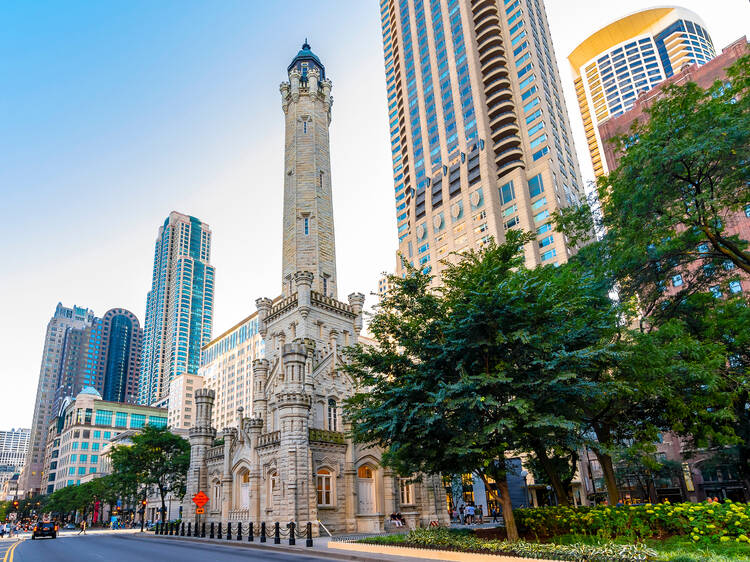
Chicago Water Tower

Photograph: Shutterstock

Chicago Water Tower

Once used to pump and hold water from Lake Michigan, the Chicago Water Tower at Michigan Avenue and Chicago Avenue was one of the few buildings in the path of the Great Chicago Fire of 1871 to survive the blaze intact. Built in 1869, the limestone building was rennovated and repaired a few decades after the fire and is sometimes mistaken for a small castle (according to WTTW host Geoffrey Baer, the design of early White Castle restaurants were based on the Chicago Water Tower). Today, the building houses an art gallery featuring the works of local creators called the City Gallery in the Historic Water Tower.

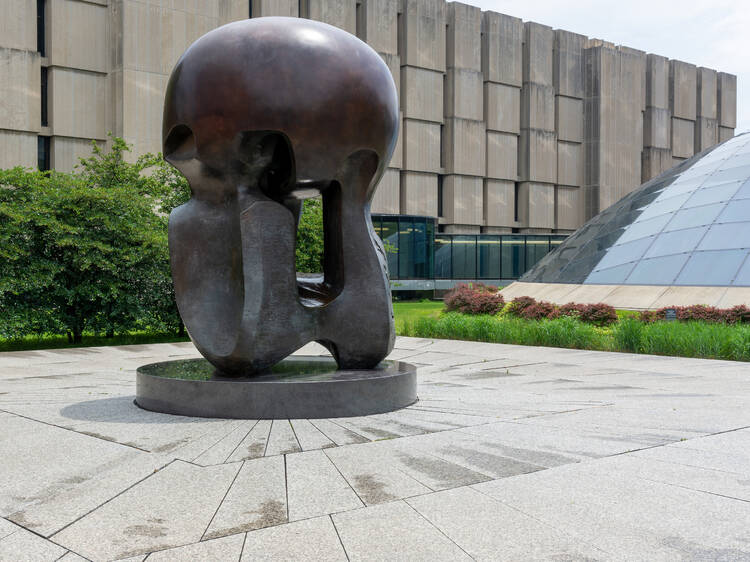
“Nuclear Energy” sculpture

Photograph: Shutterstock

“Nuclear Energy” sculpture

In 1942, Enrico Fermi led a team that achieved the world’s first man-made self-sustaining nuclear chain reaction in an artificial nuclear reactor beneath the University of Chicago’s now-demolished Stagg Field. Known as Chicago Pile-1, the reactor was the first major achievement of the Manhattan Project, which went on to develop the atomic bombs used in World War II. Today, a bronze sculpture from British artist Henry Moore called “Nuclear Energy” stands atop the former site of the reactor, just north of the glass dome of the Joe and Rika Mansueto Library on the University of Chicago campus in Hyde Park.

Pullman National Monument

Photograph: Shutterstock

Pullman National Monument

Back when folks traveled the United States via rails rather than soaring through the sky, the Pullman Company built train cars on the far South Side of Chicago. George Pullman constructed a sprawling company town for his workers, including housing, factories and a giant clock tower. A strike for better pay and a boycott of Pullman cars in the late 1800s demonstrated the power of unions, but the company soldiered on until it shuttered in the 1960s. Today, the former industrial community is a National Monument (thanks to Barack Obama) complete with a visitor center and self-guided tours of the surviving buildings.

Fine Arts Building

Photograph: Martha Williams

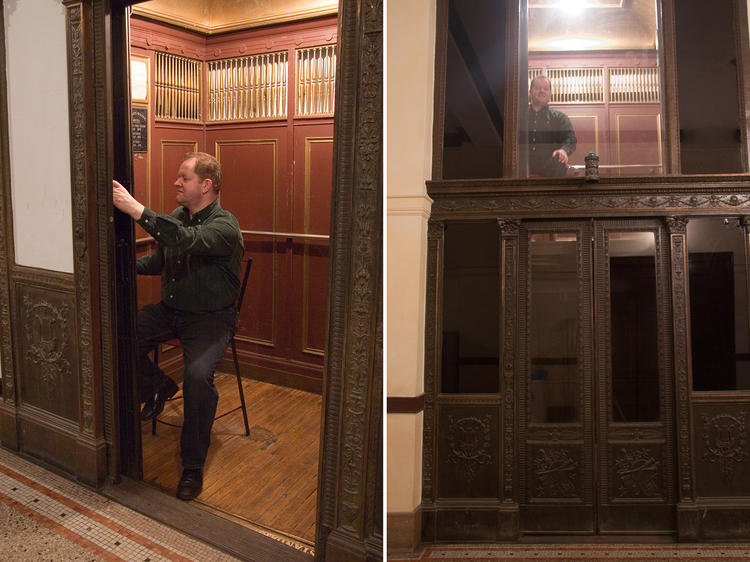
Fine Arts Building

Stately granite columns and gilded detailing offer a few obvious clues that the Fine Arts Building is a relic of Chicago history. But to get a sense of what makes the Michigan Avenue building particularly special, one only needs to take a trip upwards in one of its elevators—they’re the last publicly-accessible lifts in Chicago staffed by manual elevator operators, who sit on stools and use a lever to move the car from floor to floor. These employees are some of the last of their profession (which has largely been wiped out due to automation), so getting to see their work up close is an increasingly rare treat.

Walt Disney’s Birthplace

Before he created Mickey Mouse and founded one of the most powerful media conglomerates, Walt Disney was born inside a small house in Hermosa on December 5, 1901. Located at 2156 N Tripp Avenue, the modest two-story house was where Walt spent some of his formative years, until his family moved to Marceline, Missouri in 1906. The current owners of the Walt Disney Birthplace plan to restore the building to its original state (circa 1901) and open a small museum inside of the home.

Clarke House Museum

Photograph: Shutterstock

Clarke House Museum

Built in 1836 for hardware merchant Henry Brown Clarke, this Greek Revival-style house once sat on Michigan Avenue between 16th and 17th Streets—at the time, you could look to the west and see nothing but prairie. The house was purchased and moved south to 45th Street and Wabash Avenue in 1871 (a more common practice in the 1800s), but the city bought the house and moved it to its current location in 1977. Today, it’s the home of the Clarke House Museum, which hosts a collection of artifacts from pre-Civil War Chicago. The city calls the Clarke House “Chicago’s oldest house,” but there’s a mansion in Norwood Park that was built a few years earlier.

Alta Vista Terrace District

Photograph: Shutterstock

Alta Vista Terrace District

Wander just north of Wrigley Field in Lakeview and you might feel as though you’ve stepped into early 20th-century London—if only for one block-long stretch. Wrigleyville’s Alta Vista Terrace District, which runs north on Alta Vista Terrace from Grace Street to Byron Street, features a dense network of 40 historic row houses developed in 1904 by Samuel Eberly Gross, who aimed to recreate the harmonious architecture he saw on a trip to Europe. Walk up and down Alta Vista Terrace to spot the design’s full effect: Each home in the district features a near-duplicate copy on the diagonal side of the street, lending an especially balanced feel to the block.

January 2023 events calendar for Chicago

Begin the new year with events, festivals, concerts, theater and more great things to do in Chicago in January

Edited by
Emma Krupp

We’ll be honest: January is not exactly Chicago’s finest month. But before you start to dwell on the prospect of snow, cold and seemingly endless winter, allow us to point out some of the best ways to kick off the first few weeks of 2023. Start by catching the final days of Christmas lights in Chicago (they offer a nice excuse to take a walk outside, even when the holidays have passed) and get some fresh winter air when you take a spin around the best ice skating rinks the city has to offer. Prefer to stay inside? Tour new exhibits at Chicago museums—many of which offer free days over the next few months—or check out some of the best things to do indoors, including rock climbing, bowling and soul-warming spa days. Make a resolution to start 2023 on the right foot with the help of our guide to the best things to do in Chicago this January.

1. Chinatown Lunar New Year Parade

  • Things to do
  • Festivals
  • Armour Square

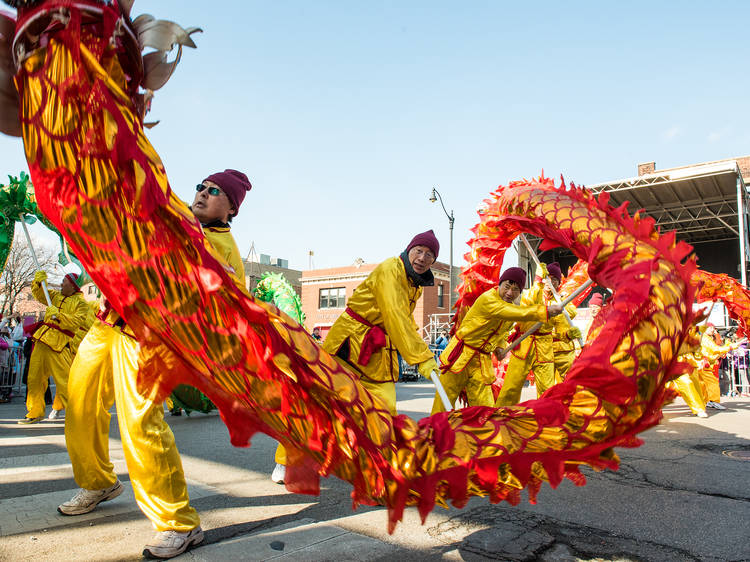
Celebrate the Year of the Rabbit in Chinatown at the neighborhood’s official Lunar New Year parade, which falls after the arrival of Chinese New Year (January 22). Attendees line Wentworth Avenue to see marching bands, decorated floats and traditional lion dancers. The colorful procession begins at 24th Street and Wentworth Avenue at 1pm, traveling north to Cermak Road.

2. Chicago International Puppet Theater Festival

  • Theater
  • Puppet shows

Can’t get enough of marionettes? You’ll love the Chicago International Puppet Theater Festival, which brings puppeteers from across the globe to the city for 12 days of symposiums and more than 100 performances and events. This year marks the festival’s first-ever establishment of a “puppet hub,” which includes site-specific events throughout different spaces in the Fine Arts Building on Michigan Avenue—take a look around to find everything from a puppet-themed cafe to film screenings in the building’s massive Studebaker Theater. Outside the hub, find productions like a puppet rendition of Hamlet at The DuSable Black History Museum and Education Center and a free touring production of My Night in the Planetarium. For a full list of performances, visit the festival’s website.

9 things to look forward to in Chicago in 2023

9 things to look forward to in Chicago in 2023

Dog shows, immersive exhibitions and new Guinness brews await you.

Written by 

Emma Krupp

 & 

Jeffy Mai


As we near the end of 2022, it’s time to start looking ahead to what’s coming in the new year. Lots of big projects are in the works, including a Guinness brewery, several new music venues and NASCAR’s first-ever street race. So don’t let the winter blues get you down—there are plenty of bucket list-worthy activities on the horizon. While delays can, and invariably do, happen, we’re optimistic that the next 12 months will bring the city a wealth of notable openings. Without further ado, here are the things we’re most looking forward to in Chicago in 2023
A dog jumps over a post at a dog show
Photograph: Winter Churchill

Finding out who’s best in show at a new dog show coming to Chicago

Kick off 2023 with the first annual edition of the Great American Dog Show, a dog show extravaganza that’s taking up residence in the Renaissance Schaumburg Convention from January 6-8 with more than 200 breeds and four participating kennel clubs in competition for a series of prizes. Tickets start at $25 per person ($20 for seniors and $15 for seniors) and grant access to demonstrations, a marketplace full of vendors selling dog-friendly goods and a series of “Meet the Breeds” booths to acquaint you with different types of pups, among other interactive features. — Emma Krupp  

Dinner and a movie at Alamo Drafthouse 

In February, the Texas-based movie theater chain Alamo Drafthouse—famous for its food options, themed screening nights and strict no-cellphone policy—revealed its debut Chicago location was headed to Wrigleyville. Beginning in January, Chicago moviegoers can finally catch a flick at the six-screen theater, which is taking up residence in the Addison and Clark development near Wrigley Field. Might we suggest a viewing of the latest Avatar installment? —EK
The Chicago skyline and the Morton Salt building in the foreground
Photograph: Sandra Steinbrecher

Catching a concert inside the former Morton Salt Building

After debuting its outdoor venue last summer, Salt Shed will finally open the long-awaited indoor portion of its venue complex at the site of the former Morton Salt Factory on February 17, complete with a roster of food and drink options that will eventually include Goose Island’s new brewpub. The inaugural lineup is pretty good, too, with appearances from Third Eye Blind, The Roots, Bikini Kill and Iggy Pop—though be warned that some of these shows are already sold out, so better snag tickets sooner rather than later. — EK

Guinness pints
Photograph: Shutterstock

Sipping brews at the Guinness factory opening

Do you remember way back in 2021, when Guinness announced it was bringing its second U.S. taproom to the West Loop? That vision is finally coming to reality sometime in early 2023, when the taproom and brewery is slated to debut inside 15,000-square-foot space housed in a former railroad depot at 375 N Morgan Street. Visitors can expect to sip brews exclusive to the Chicago location, hopefully in time for St. Patrick’s Day revelry this March. — EK

NASCAR cars on a track
Photograph: Shutterstock

Watching cars rip down Michigan Avenue during NASCAR’s first-ever street race

Chicago’s plans to host a weekend of NASCAR street racing was controversial from the start—and a recent WBEZ analysis found that the deal provides “minimal financial benefit” to the city— but you can’t deny it will at least be interesting to see race cars zooming along Grant Park at breakneck speeds when the event rolls into town over Fourth of July weekend. Prepare to fork over a pretty penny if you’re hoping for tickets; general admission passes haven’t gone on sale yet, but reserved seats currently start at $415, with certain VIP packages soaring to an eye-popping $4,300 a ticket. — EK

The exterior of Double Door
Photograph: CC/Flickr/Subbu ArumugamThe original Double Door in Wicker Park.

Rocking out at the new Double Door

Chicagoans mourned the closing of beloved music venue Double Door after it was evicted from its longtime Wicker Park home in 2017. But sorrow should soon turn to joy as Double Door is making its return next year inside the Wilson Avenue Theater in Uptown, a century-old building that’s currently under renovation. The finished project will have two mezzanine levels on top of the main floor, a balcony plus a lounge in the basement, Block Club Chicago reports. And it’ll also sport a new 17-foot-tall sign—a nod to the original club’s iconic neon sign that was taken down. — Jeffy Mai

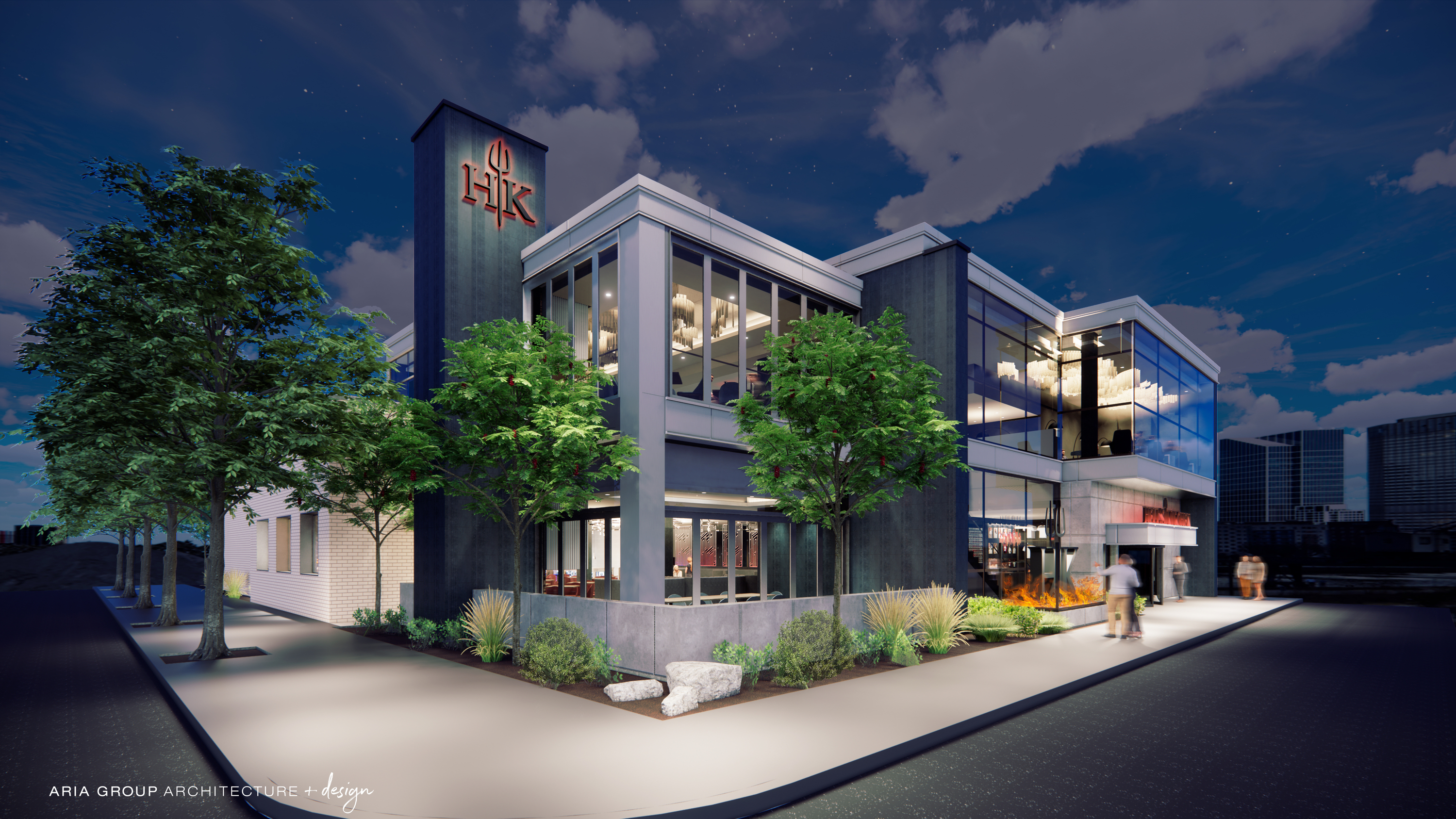
Hell’s Kitchen rendering
Photograph: Courtesy of Gordon Ramsay North America

Sitting down to meal at Gordon Ramsay Hell’s Kitchen

Celebrity chef and polarizing television personality Gordon Ramsay is bringing his notorious restaurant Hell’s Kitchen to Chicago. Inspired by the eponymous cooking competition, it will span two stories and 18,000 square feet in River North, with a vertical, airy design intended to evoke the history of the city’s skyscrapers. On the food side, expect signature items like beef Wellington and sticky toffee pudding. Hell’s Kitchen will be Ramsay’s second concept, joining Gordon Ramsay Burger. — JM

A rendering of Ramova Theater
Photograph: Courtesy of O’Riley Office

Enjoying a beer and a show at a restored Bridgeport venue

A historic Bridgeport development is coming back to life next year as a mixed-use venue. Originally opened in 1929, Ramova Theater operated as a cinema house until its closure in 1985. Now, a complete restoration is underway, which will transform it into a live music hall flanked by a brewpub and a restaurant according to Block Club Chicago. The Duck Inn chef Kevin Hickey will be in charge of the food concept and he plans to pay tribute to Ramova Grill—the diner previously attached to the theater—by bringing back its most popular dish, chili. — JM

Illuminarium rendering
Photograph: Courtesy of the Rockwell Group

Going on an immersive adventure without leaving the city

Navy Pier is helping locals see the world with a new attraction in 2023. A 32,000-square-foot immersive space, dubbed Illuminarium, will transport visitors to far-flung places through virtual reality-esque exhibits that feature laser projections, 3D audio, scents and more. The multi-sensory experience will include an African safari and a trip through the solar system, so there are surprises in store for even the most seasoned travelers. — JM

December Is The Perfect Time To See Chicago, Local Tour Guide Says

by:


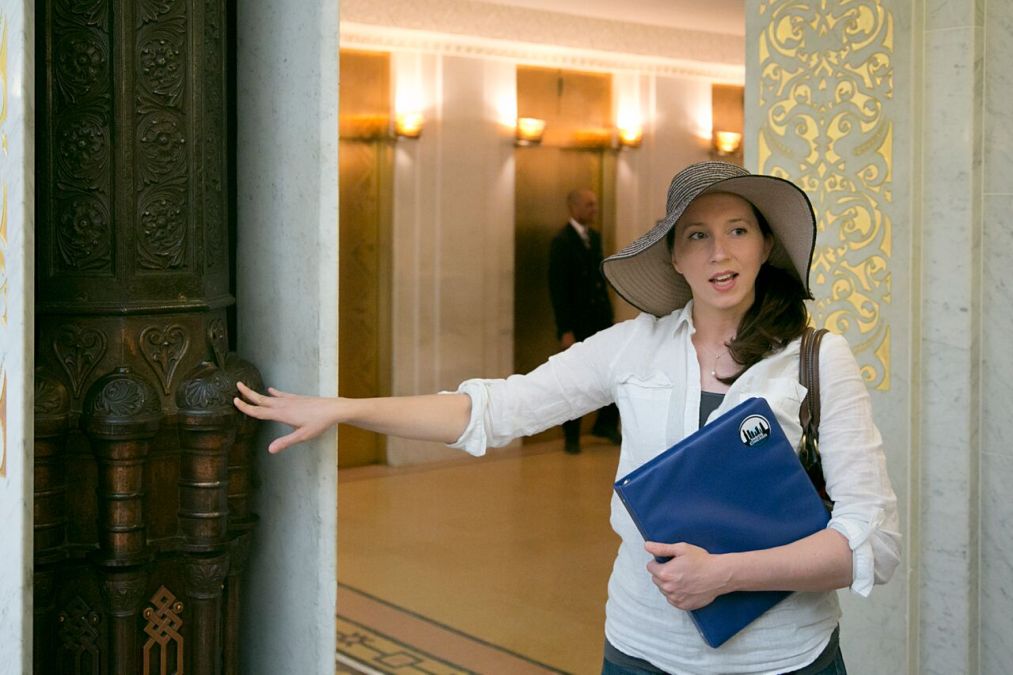
Hilary Marzec has long introduced Chicagoans and tourists to the beautiful interiors of lesser-known Loop buildings.

Longtime tour guide Hillary Marzec shows people Chicago’s artful interiors.
Hillary Marzec
  • Credibility:

DOWNTOWN — Chicago’s peak tourism season has come and gone, but local tour guide Hillary Marzec still wants to take you inside some of the Loop’s most stunning buildings.

Marzec runs her tour business, Inside Chicago Walking Tours, out of a Rogers Park office and calls herself a Downtown “architecture nerd.”

For years, Marzec gave architecture tours via river boat but branched out on her own to “help people see the details up close,” she said.

Inside Chicago Walking Tours offers $35 tickets throughout the winter and pay homage to the lesser-known buildings of the Loop, which people may pass over en route to “the big hitters” like the Sears Tower and Chicago Cultural Center, Marzec said.

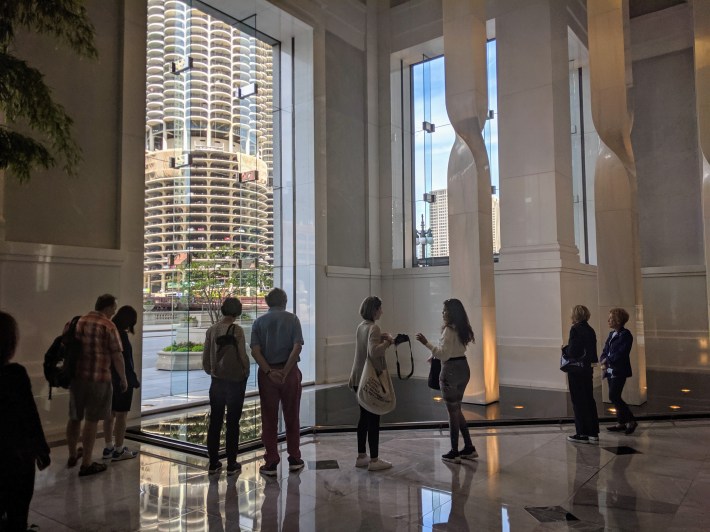
“The best type of cold-weather tour is a walking one, because we can always go inside,” Marzec said. “When we bring people to lobbies, we always give them some breathing space first, just so they can experience it as an art.”

Credit: Hillary Marzec
Longtime tour guide Hillary Marzec takes people around the Loop.

One of Marzec’s favorite buildings to show people is at 311 S. Wacker Drive across the street from the Sears Tower.

The building “looks like a birthday cake on top because of its big drum of lights,” she said. But its most dazzling element might be the sunken lobby, “an oasis that lets you escape the bustle of Wacker Drive,” Marzec said.

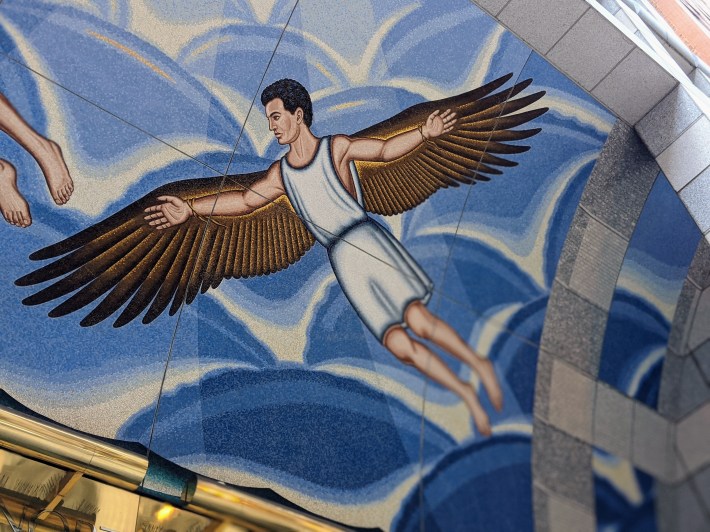
The mosaic by famed artist Roger Brown at 120 N. LaSalle St. is another highlight, which tells the tale of Icarus and Daedalus and the perils of ambition, Marzec said. A segment of the mosaic is a blank column, meant to reflect the building across the street — none other than City Hall, Marzec said.

“Just from any one building, there’s just so much you can pull apart and teach people about, which is generally not offered in most run-of-the-mill big box tour experiences,” Marzec said. “What connects the architecture of the Loop, from the known to the lesser known, is the quality of the design, the intentionality of the design. It’s like cruising through a fine art museum.”

Credit: Hillary Marzec
A blank column in Roger Brown’s mosaic reflects the “perils of ambition” at City Hall across the street.

Marzec also offers virtual tours for groups and corporations. She hopes to bring back the part-boat, part-walking “Surf & Turf” tours once the weather warms up.

For Chicagoans trying to get their friends and relatives to come to town during the holidays, Marzec also offers gift cards.

“People in the summer ask me all the time, ‘How do you get through the winter here?’” Marzec said. “We wear hats and get back to work.”


Lincoln Park Zoo Is on Lion Watch, New Cub Due in January

Lincoln Park Zoo Is on Lion Watch, New Cub Due in January

Zari, Lincoln Park Zoo's 4-year-old African lion, is expecting a litter in January. Here she is with her cub, Pilipili, born in March 2022. (Lincoln Park Zoo / Diana Miller)Zari, Lincoln Park Zoo’s 4-year-old African lion, is expecting a litter in January. Here she is with her cub, Pilipili, born in March 2022. (Lincoln Park Zoo / Diana Miller)

Lose a Cub (so long, Willson Contreras), gain a cub.

The Lincoln Park Zoo announced Friday that its pride of African lions is set to welcome a new arrival, or arrivals, in January.

Staff confirmed via ultrasound that 4-year-old Zari is pregnant. She and her 5-year-old mate, Jabari, are also parents to 9-month-old Pilipili, who was born in March.

“This is a very exciting time for the lion pride at the zoo but also for the entire zoo population. A birth represents preservation of a species that has faced many challenges in the wild,” said Mike Murray, curator of mammals and animal behavioral husbandry, in a statement.

Gestation for African lions is roughly 110 days, typically resulting in litters of one to five cubs, according to the zoo.

While cubs only weigh a few pounds at birth, full grown lions can weigh up to 500 pounds. Pilipili, a male, is already sporting the hint of a mane and can be seen playing with the other lions.

The zoo will post regular #LionWatch updates on its FacebookInstagramTikTok and Twitter channels, as well as on the zoo blog and ZooMail, a biweekly news digest.

Holiday Season Is Officially On As Chicago’s 55-Foot Christmas Tree Is Lit In Millennium Park

The 109th Annual Christmas Tree Lighting Ceremony at Millennium Park on Nov. 18, 2022.
Colin Boyle/Block Club Chicago

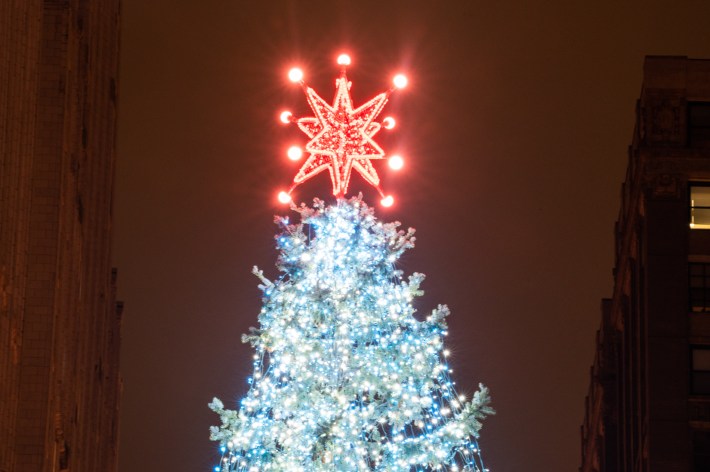
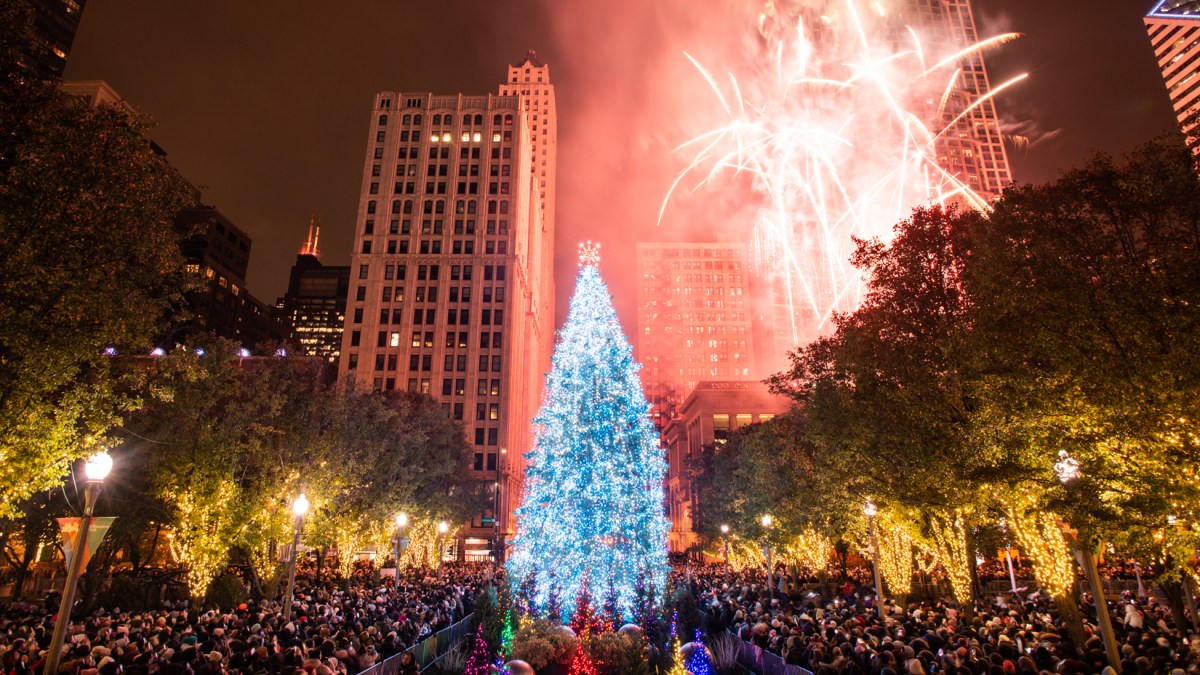
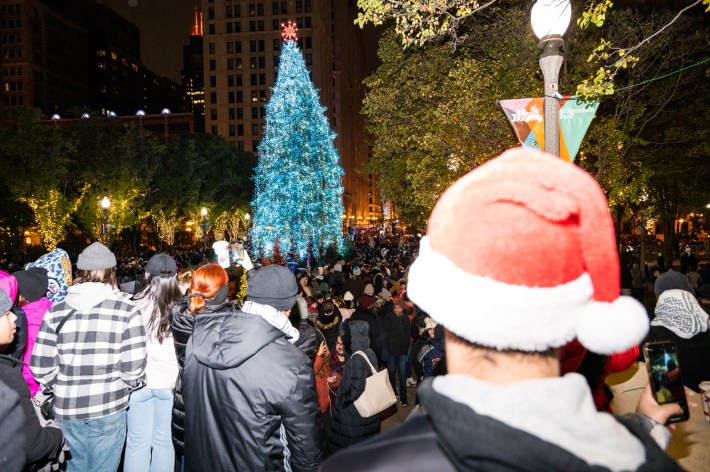
MILLENNIUM PARK — As flurries created a Chicago snow globe Friday night, the switch was flipped on Millennium Park’s Christmas tree for the first time this season, drawing an eruption of cheers and fireworks.

Thousands crowded into the park to kick off the holiday season with the 109th annual lighting of Chicago’s official tree. The star of the show was a 55-foot Colorado blue spruce donated by the Glisovic family of Morton Grove.

The tree stands in the park, near the corner of Michigan Avenue and Washington Street. It will be there until January 9.

Before the park echoed with the tree lighting countdown there were musical performances by Son Monarcas; “Wicked” cast members Lissa deGuzman (Elphaba) and Jennafer Newberry (Glinda); DJ Mwelwa and Cabaret ZaZou.

Chicago’s Dreezy Claus and Sister Claus spoke to the children and encouraged them to be nice, and not naughty.

Here are some photos from the festive night:

Credit: Colin Boyle/Block Club Chicago
The 109th Annual Christmas Tree Lighting Ceremony at Millennium Park on Nov. 18, 2022.
Credit: Colin Boyle/Block Club Chicago
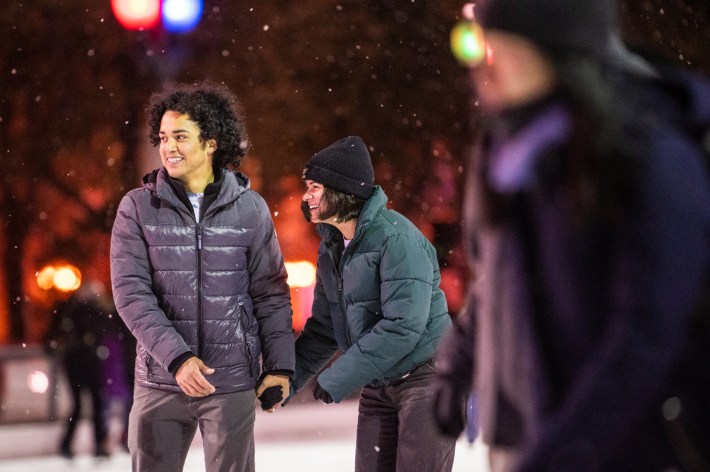
Alfonso and Kimberly ice skate during the 109th Annual Christmas Tree Lighting Ceremony at Millennium Park on Nov. 18, 2022.
Credit: Colin Boyle/Block Club Chicago
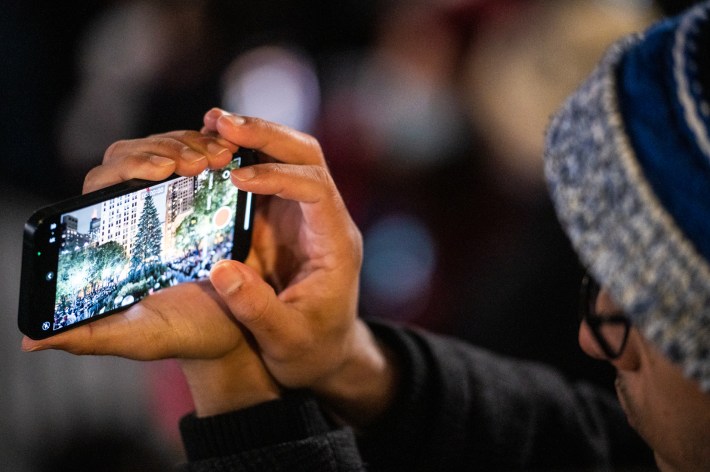
A person films the Christmas tree before the 109th Annual Christmas Tree Lighting Ceremony at Millennium Park on Nov. 18, 2022.
Credit: Colin Boyle/Block Club Chicago
People shop and sell at the Art Market during the 109th Annual Christmas Tree Lighting Ceremony at Millennium Park on Nov. 18, 2022.
Credit: Colin Boyle/Block Club Chicago
The 109th Annual Christmas Tree Lighting Ceremony at Millennium Park on Nov. 18, 2022.

Christmas Tree Ship

Coast Guard crew carrying Christmas Tree Ship load is crossing Lake Michigan

U.S. Coast Guard Cutter Mackinaw

Members of the Cheboygan community and a local high school helped the Mackinaw crew load trees for its annual Christmas Tree Ship run to Chicago. Photo provided by the U.S. Coast Guard.

The crew of the U.S. Coast Guard Cutter Mackinaw is motoring down Lake Michigan today and nearing Chicago, where its load of more than 1,200 Christmas trees will be used to recreate the holiday spirit of Michigan’s ill-fated Christmas Tree Ship, which sank in late November 1912.

The rugged, 240-foot icebreaker left Cheboygan, Michigan on Saturday after volunteers from the nearby Wolverine High School and the community helped the Mackinaw’s crew load the hundreds of net-wrapped trees onto the cutter’s fantail. For the commemorative trip, the Mackinaw is also flying a custom-made tree pennant, the Coast Guard said.

The journey has been a sentimental favorite for the cutter’s crew and groups in Northern Michigan and Chicago for years.

U.S. Coast Guard Cutter Mackinaw

The U.S. Coast Guard Cutter Mackinaw, loaded with 1,200 Christmas Trees, traveled under the Mackinac Bridge on its way to Chicago. Photo provided by the U.S. Coast Guard.


“The Mackinaw does this to honor the Rouse Simmons, a three-masted schooner which tragically sank in 1912 while sailing to Chicago to deliver Christmas trees. We are honored to carry on this Christmas tradition and spread holiday cheer!” the crew said in a recent social media post.

Click here to see a Coast Guard video of the crew and their helpers loading the Mackinaw.

Earlier this weekend, spectators gathered in Northern Michigan as the ship left its pier, bound for Chicago. “1,200 Christmas trees secured to the fantail, a custom tree wind pennant compliments of the CO (well done, Captain!), and Santa and his elf dancing on the flybridge…. Its official- U.S. Coast Guard Cutter Mackinaw WLBB 30 is underway for their annual Christmas tree run!,” the U.S. Coast Guard Great Lakes group said Saturday in a social media post. “The crew is in high spirits as spectators waved and cheered the ship off the pier. Stay tuned to see what Mackinaw and her crew are up to as they transit to #Chicago to complete this unique mission!”

The holiday trees are funded by donations to Chicago’s Christmas Ship committee. They’ll be delivered to that city’s Navy Pier, where the trees will be distributed to Chicagoans for their holiday celebrations. The Mackinaw crew is also getting some of its late fall work done during the journey, with some buoy-tending along the way.

"Captain Santa"

“Captain Santa” and two crewmen on the deck of the Rouse Simmons

As it has for decades, the Coast Guard is recreating the Christmastime journey of the Rouse Simmons, which sank on Nov. 23, 1912 in a fierce gale off the coast of Two Rivers, Wisconsin.

Built in 1868 in Wisconsin, the Rouse Simmons was one of many Great Lakes maritime workhorses, ferrying lumber and other cargo from port to port.

By 1910, Capt. Herman Schuenemann owned a small interest in her. For years, his family had been among the two dozen schooner crews doing late-season Christmas tree runs, bringing evergreens from northern Michigan and Wisconsin to Chicago’s docks. The ships would be decorated with lights, and the families could come aboard and pick out an inexpensive tree. By cutting out the retail middleman, captains could get a decent profit from a holiday run.

Known for his generosity,  Schuenemann earned the nickname “Captain  Santa.” On its last run in 1912, the Rouse Simmons was crammed with more than 5,000 trees, enough to make some say the ship looked like a floating forest when it set off from Thompson, Michigan, near the Upper Peninsula’s Manistique, on Friday, Nov. 22, 1912. By the next afternoon, the ship was gone.

The entire crew was lost, believed to be around 14 men. There were also accounts that lumberjacks working in Northern Michigan had hitched a ride, trying to get home to Chicago for Christmas. That would push the death toll to possibly 23.

The Christmas tree cargo has become a tradition for the Coast Guard. In the last 20 years, the cutter Mackinaw and its predecessor of the same name have delivered more than 25,000 Christmas trees to Chicago families.

Rouse Simmons shipwreck

Bow of the Rouse Simmons with a Christmas tree placed on her deck

https://www.mlive.com/news/2022/11/coast-guard-crew-carrying-christmas-tree-ship-load-is-crossing-lake-michigan.html

Skate inside Wrigley Field this holiday season

Written by 

Jeffy Mai

The holiday season is right around the corner and this year, Chicagoans have the rare opportunity to step onto Wrigley Field.

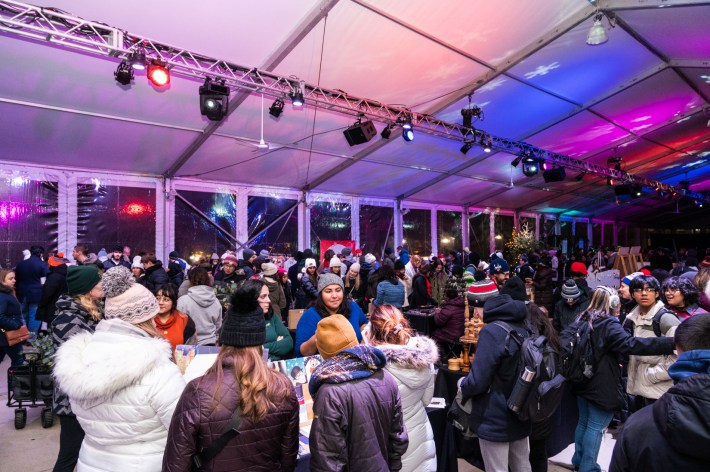
Winterland at Gallagher Way, the annual festive experience that takes place outside the home of the Cubs, is expanding into the ballpark for the first time this year. Starting Friday, November 18 and running through Sunday, January 8, 2023, visitors will be able to celebrate the season with a host of programs and activities. Popular winter attraction Christkindlmarket Wrigleyville returns as one of the headliners and will offer hand-crafted ornaments and unique holiday merchandise plus a taste of traditional German fare and hot spiced wine.

A large Christmas tree and crowds at Winterland at Gallagher Way

While Winterland’s ice skating has customarily happened next to the stadium, the festivities are moving onto the field in 2022. Attendees will be able to make their way through a special gate filled with holiday decor before arriving at an expanded 12,000-square-foot ice rink. The whimsical wonderland will also feature a carousel, carnival rides and games, an ice slide and an Infield Express train. And if you need to warm up, there’s a new ski lodge-themed dining option—aptly named The Lodge—that will provide creative beverage offerings as well as fire pits.

Those who want to commemorate the occasion can take professional family photos with Santa in his workshop, located in the lobby near the Wrigley Field Marquee. It will be open every Friday, Saturday and Sunday from November 25 to December 18. Large groups can rent private on-field chalets, which are designed to accommodate up to 20 guests. They include a hot chocolate bar, snacks, attraction tickets and upgradeable food and drink packages. Reservations are available here.

Admission to Winterland at Gallagher Way is free, but tickets are required for access to the Wrigley Field activities. Tickets start at $5 and can be purchased online. Parking is available in the Toyota Camry Lot at 1126 W Grace St for $10 Monday through Thursday, and $15 Friday through Sunday. Winterland’s hours of operation are from 3-9pm Monday through Thursday, 11am-10pm on Saturday and 11am-7pm on Sunday. Thanksgiving and Christmas Eve hours will be 11am-4pm, while the hours on December 26-29 will be 11am-7pm. The event is closed on Christmas Day. For a full list of activities and events, visit Gallagher Way’s website.